How to choose a folding table
“Quality” is often cited by customers as the most important factor when choosing their table supplier and typically encompasses durability, lightweight, ease of handling, and ease of maintenance. Of late, many customers stress that purchasing tables are capital decisions so the motivation is ROI. “We want to buy products that will last a long time and whose manufacturers are accountable and will be there if there is a problem or a need to replicate or replace,” states a hospitality purchaser of Mity-Lite tables and chairs.
As such, it is important to understand that many advances in materials and manufacturing processes have increased a customer’s folding table purchasing options. Among the varied tables lines available today are: plywood, laminate, plastic, and aluminum. The customer’s overall experience and cost of ownership have much to do with the type of folding table they select.
Types of folding tables
Particle Board Tables:
Available since the mid-1900s, thick particleboard melamine tables continue to be the lowest cost folding table option, but the one-year limited warranty they typically carry speaks for itself. These tables are heavy, very susceptible to breakage, and don’t support much weight.
Plywood Tables:
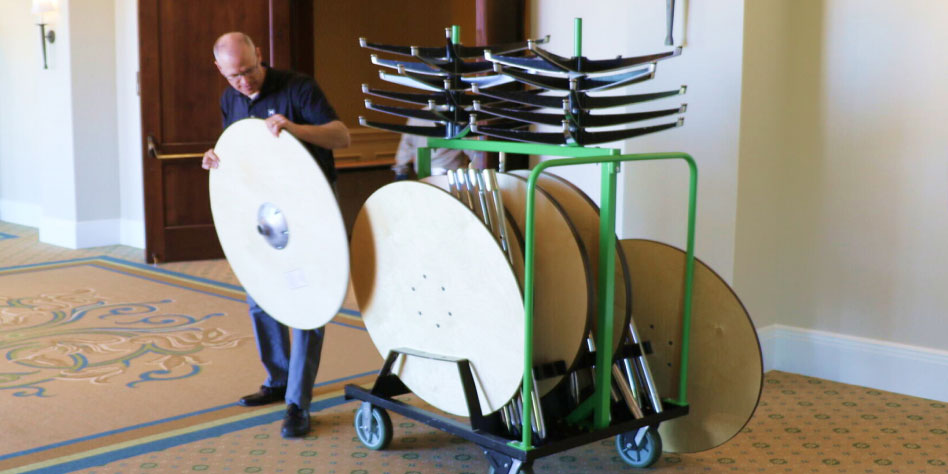
A long-standing staple in the hotel banquet world, plywood tables are rigid and fairly strong, but are typically on the heavier end of the table spectrum. And, because they’re wood, many plywood tables are susceptible to cracking, warping, and splintering. Recently, Mity-Lite addressed these durability and handling issues through its Madera Plywood table line , which provides the industry design improvements such as high-end acrylic finishes (to the top and bottom of the table surface) and through the use of aluminum runners.
High Pressure Laminate Tables: These folding tables use a laminate sheet similar to those found on kitchen countertops for the tabletop surface which is adhered to a plywood sub-surface. This style of table has the rigidity and strength of plywood, while providing additional durability and customization options. Laminate folding table surfaces are stain-resistant, won’t crack or splinter, resist heat and water damage, and are easy to clean. Depending on the style and quality of the laminate, they can also be used without linens.
Plastic Tables:
There are generally two types of plastic folding tables: “blow-molded” polyethylene and “thermoformed” ABS. There are vast differences in performance and durability between these two types of plastic tables. Originally developed for the residential market, blow-molded tables gained increased use in limited commercial markets due to their cost and availability. Blow-molded plastic tables have a slightly textured surface, are typically easy to clean, and lightweight. However, due to the manufacturing process, blow-molded tables do not have an internal frame structure and are thus weaker, less durable, and more susceptible to having an uneven table surface.
A thermoformed ABS plastic table typically has an internal wooden frame with ABS plastic sheets vacuum-formed around it. This construction method adds strength, durability, and higher load bearing characteristics to the table without significantly adding weight. The ABS plastic surface is also considered superior for its hardness, gloss, and toughness. The best ABS plastic tables from Mity-Lite can support over 2,000 lbs., have a thin wood laminate sub-surface (that provides moderate heat shielding and keeps the table surface smooth and flat), and can be used for indoor and outdoor functions.
Aluminum Tables:
Newer to the market, these folding tables are among the lightest and strongest (some able to support over 3,000 lbs), but carry a higher cost. Aluminum table surfaces are maintenance-free and the seamless versions provide a more sanitary option, such as for kitchens or banquet areas. Despite the cost, aluminum tables can last a lifetime, don’t require linens, and are ideal for outdoor use as well.